The Mobility Misconception
When most people hear "mobility work," they picture a yoga class or a foam roller session that feels nice but doesn't seem to do much. Mobility has a reputation as the soft, optional add-on to "real" training — something you do when you're injured or when you have extra time, which is never.
This is a costly misconception. Mobility is the foundation of strength training. Without adequate range of motion in your hips, shoulders, ankles, and thoracic spine, you cannot perform the fundamental movement patterns — squat, hinge, push, pull — with the mechanics needed to load them safely and effectively.
What Mobility Actually Is
Mobility is not the same as flexibility. Flexibility is passive — it's how far a muscle can be stretched when an external force is applied. Mobility is active — it's your ability to move a joint through its full range of motion under your own muscular control.
You can be flexible without being mobile. A person with tight hip flexors might be able to passively stretch into a deep hip position, but if they can't actively control that position under load, they have flexibility without mobility. Strength training requires mobility, not just flexibility.
How Limited Mobility Limits Strength
Let's look at the squat as an example. A full-depth squat requires:
- Adequate ankle dorsiflexion (the ability to bring your shin forward over your foot)
- Hip flexion mobility (the ability to bring your thigh toward your torso)
- Thoracic extension (the ability to keep your chest up and spine neutral)
- Hip external rotation (the ability to track your knees over your toes)
If any of these are limited, your body will compensate. Heels rise. Knees cave. Lower back rounds. Chest drops. These compensations don't just reduce the effectiveness of the exercise — they create shear forces on joints that, over time, lead to pain and injury.
The same principle applies to the deadlift (hip mobility), overhead press (shoulder and thoracic mobility), and bench press (thoracic spine extension). Every major compound lift has mobility prerequisites.
The Mobility-Strength Connection
Here's something that surprises many people: improving mobility often immediately improves strength. When you can access a deeper squat position with a neutral spine, you engage more muscle. When your shoulders can move through full range without compensating, you can press more effectively. When your hips can hinge properly, your deadlift mechanics improve and your lower back stops doing the work your glutes should be doing.
Mobility work isn't just injury prevention — it's performance enhancement.
The Most Important Mobility Areas for Lifters
1. Hip Mobility
The hips are the powerhouse of the body. Limited hip mobility affects squats, deadlifts, lunges, and even pressing movements (through pelvic tilt and lumbar compensation). Key areas: hip flexors, hip external rotators (piriformis, glute med), and hip internal rotation.
2. Thoracic Spine Mobility
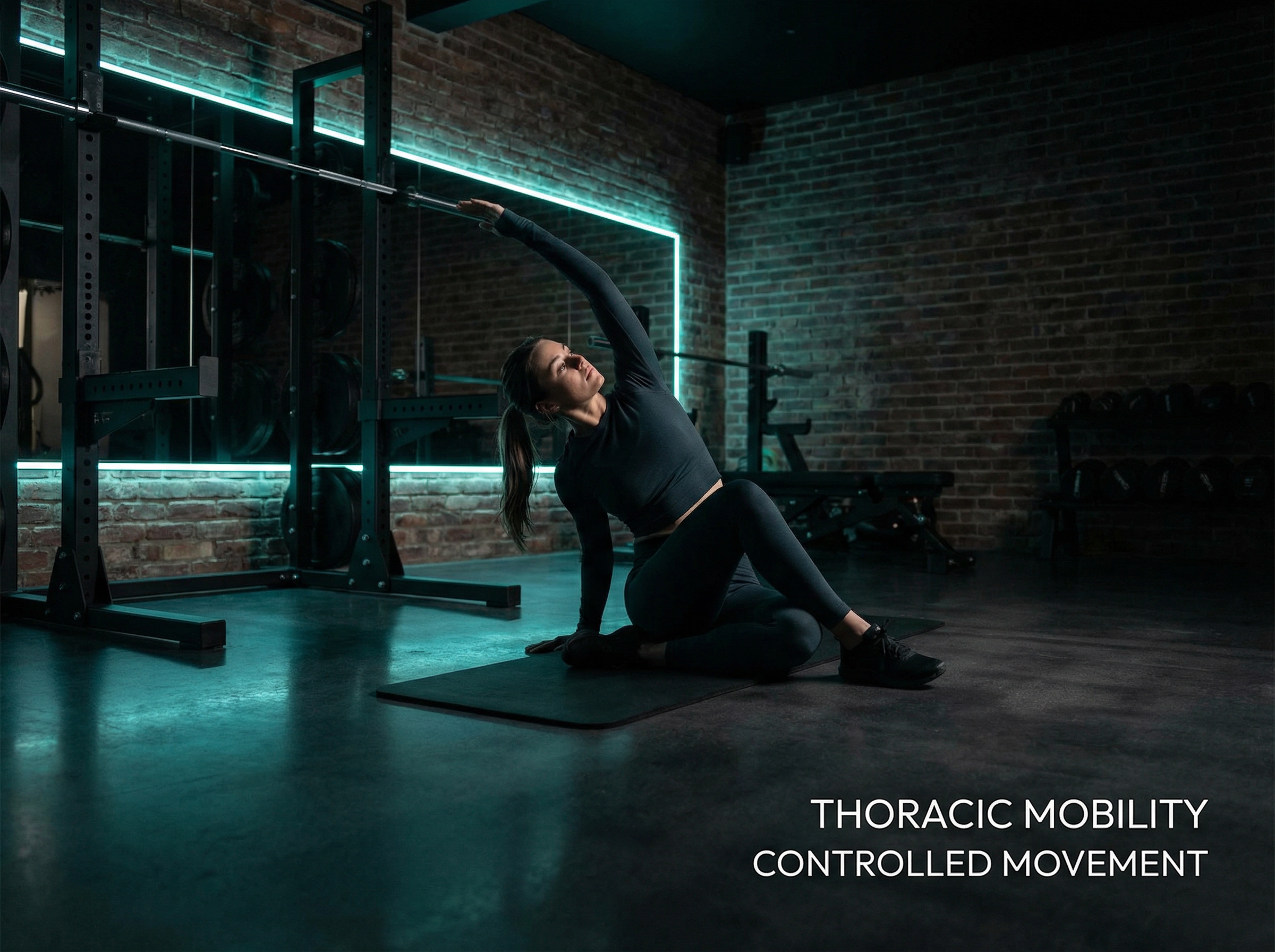
The thoracic spine (mid-back) should be mobile. When it's stiff — which is extremely common in desk workers — the lumbar spine and shoulders compensate. This leads to lower back pain during deadlifts and shoulder pain during pressing. Thoracic extension and rotation drills are non-negotiable for most lifters.
3. Ankle Dorsiflexion
Tight ankles are one of the most overlooked causes of squat problems. When your ankle can't dorsiflex adequately, your heel rises, your knee tracks inward, and your lower back rounds. Ankle mobility work — including calf stretching and joint mobilization — can dramatically improve squat depth and mechanics.
4. Shoulder Mobility
The shoulder is the most mobile joint in the body, which also makes it the most vulnerable. Adequate shoulder mobility requires good glenohumeral range of motion, scapular control, and thoracic extension. Deficits here show up as shoulder impingement, rotator cuff issues, and elbow pain during pressing.
How to Integrate Mobility Into Your Training
The most effective approach is to integrate mobility work into your warm-up and training sessions, not treat it as a separate activity you do when you have time.
- Pre-training: Dynamic mobility drills specific to the movements you're training that day (hip circles before squats, thoracic rotations before pressing)
- Between sets: Active stretching of the muscles you're working, in the positions you're training
- Post-training: Longer-hold static stretching and foam rolling for tissue quality
- Daily habits: 10-15 minutes of targeted mobility work on your most restricted areas
The Long Game
Mobility improvements take time. Unlike strength, which can improve week to week, tissue quality and joint range of motion changes happen over months. The key is consistency — daily work on your most restricted areas, integrated into your training rather than treated as an afterthought.
The lifters who stay healthy and continue to make progress into their 40s, 50s, and beyond are the ones who took mobility seriously early. The ones who didn't are the ones with replaced hips and chronic back pain.
Getting Started
If you're not sure where your mobility limitations are, a movement assessment is the best starting point. At Akesthetics Fitness, every new client goes through a Functional Movement Screen before we build their program. This tells us exactly where the restrictions are and what to prioritize.
Ready to move better and lift more? Book a free consultation and let's assess your movement together.