
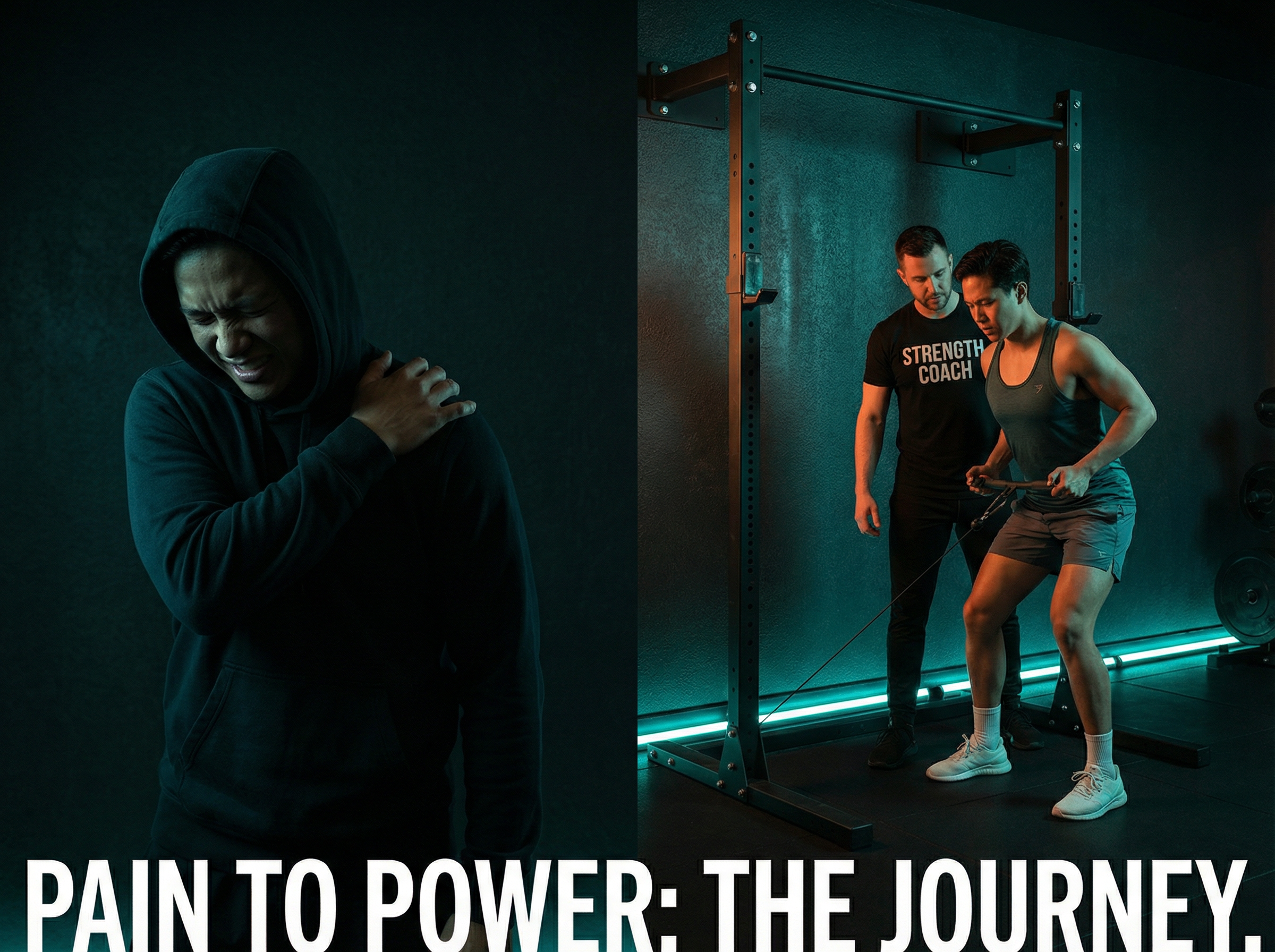
Understanding Pain During Exercise
Pain during exercise is one of the most misunderstood signals in fitness. For years, the culture around training has glorified the phrase "no pain, no gain" — but this mindset has sent countless people to the physio's office and kept many more from ever stepping into a gym at all.
Here's the truth: pain is information, not a badge of honor. When your body hurts during movement, it's communicating something specific. Learning to listen — and respond intelligently — is the difference between training that builds you up and training that breaks you down.
The Difference Between Discomfort and Pain
Before we go further, we need to separate two things that people often confuse: training discomfort and pain.
Training discomfort is the burning sensation in your quads during a hard set of squats. It's the fatigue in your shoulders at the end of a pressing session. It's the "good hurt" that tells you you've worked hard. This is normal and expected.
Pain is different. It's sharp, stabbing, or shooting. It's localized to a specific joint. It changes your movement pattern. It persists after training. It wakes you up at night. This kind of signal should never be ignored or pushed through.
The Most Common Pain Patterns We See
At Akesthetics Fitness, we work with clients dealing with a range of pain patterns. Here are the most common:
- Shoulder pain during pressing or overhead movements — often related to rotator cuff impingement or poor scapular control
- Knee pain during squats or lunges — frequently caused by poor hip mobility, weak glutes, or faulty landing mechanics
- Lower back pain during deadlifts or bending — usually a hip hinge pattern problem, not a "weak back"
- Hip tightness and anterior hip pain — commonly linked to hip flexor dominance and poor posterior chain activation
A Framework for Training Around Pain
The goal isn't to avoid training when you're in pain — it's to train smarter. Here's the framework we use with every new client:
Step 1: Identify the Movement That Causes Pain
Be specific. Is it a squat? A deadlift? Overhead pressing? Knowing the exact movement pattern that triggers pain gives us a starting point for assessment. Pain that appears in multiple movements is often systemic — related to posture, breathing mechanics, or global tension patterns.
Step 2: Assess the Root Cause
Pain at a joint is rarely caused by that joint alone. Knee pain is often a hip problem. Shoulder pain is often a thoracic spine problem. Lower back pain is often a hip mobility problem. A proper movement assessment — like the Functional Movement Screen (FMS) — helps identify where the dysfunction is actually coming from.
Step 3: Find Your Pain-Free Range
Almost every exercise has a modification that removes pain while still training the target muscle. Squats causing knee pain? Try box squats with a reduced range of motion. Deadlifts causing back pain? Try Romanian deadlifts or trap bar deadlifts. The goal is to keep training while the root cause is addressed.
Step 4: Address the Root Cause Directly
This is where corrective exercise, mobility work, and targeted strengthening come in. We're not just managing symptoms — we're fixing the underlying dysfunction. This might mean hip flexor stretching, glute activation work, thoracic mobility drills, or rotator cuff strengthening, depending on what the assessment reveals.
Step 5: Progressively Reload
Once the root cause is addressed and movement quality improves, we gradually reintroduce the full movement pattern with appropriate load. This is done systematically, not impulsively. Rushing this step is how people re-injure themselves.
What You Should Never Do
A few things that make pain worse, not better:
- Continuing to train through sharp, joint-specific pain
- Taking anti-inflammatories to mask pain so you can keep training
- Avoiding all exercise because one movement hurts
- Assuming rest alone will fix a movement dysfunction
- Comparing your pain to someone else's experience
When to See a Professional
If pain is severe, persistent (lasting more than 2 weeks), or accompanied by swelling, numbness, or tingling, you should see a sports medicine physician or physical therapist before continuing to train. A good trainer works alongside these professionals — not instead of them.
At Akesthetics Fitness, we regularly coordinate with physical therapists and sports medicine doctors to ensure our clients get the full picture. Your health comes first, always.
The Bottom Line
Training without pain isn't about avoiding hard work. It's about working hard in a way that your body can sustain. When you address the root cause of pain rather than training around it indefinitely, you unlock a level of performance that "push through it" training never could.
If you're dealing with chronic pain during training and you're in the Los Angeles area, book a free consultation with us. We'll assess your movement, identify what's going on, and build a plan that gets you training pain-free — and stronger than before.